
14 March 2025
Bologna Airport: record traffic and investments in 2024
Passenger growth, infrastructural enhancement and focus on sustainability for the 7th airport in Italy by number of passengers. Catania was the busiest route, followed by Tirana and Barcelona
2024 was a year of strong growth for Bologna Airport, both in terms of passenger traffic and economic-financial performance and investments. With over 10.7 million passengers (+8.1% compared to 2023) and a constant flow above one million monthly from May to October, Bologna Airport is confirmed as seventh in Italy in terms of passenger numbers and fourth in cargo traffic (source: Assaeroporti and Aeroporti 2030, December 2024).
At the infrastructure level, 42.6 million euros were invested in 2024 for expansions, redevelopment and sustainability interventions. The main works carried out include the reconfiguration of the Schengen departure hall, the new multi-storey car park and the installation of new, more efficient security control lines.
Nazareno Ventola, CEO and General Manager of Guglielmo Marconi Airport in Bologna, underlined how 2024 marked a turning point in the airport's transformation process, paving the way for a new phase of technological and sustainable development. President Enrico Postacchini also highlighted the strategic role of the airport, with record traffic and the commitment to more efficient management thanks to the transition to a coordinated airport.
Key numbers for 2024
- 10,775,972 passengers (+8.1% on 2023)
- 83,264 movements (+5.9%)
- 56,371 tons of goods (+10.5%)
- Average load factor at 83.4% (+0.9 points compared to 2023)
- International traffic at 75.2%, with strong growth in non-EU routes (+12%).
Catania was the busiest route, followed by Tirana and Barcelona, while on the cargo front the airport recorded a significant increase of 10.5% despite the uncertain global economic context.
Investments for the future
The airport will continue its development plan with a total investment of around 200 million euros in the four-year period 2023-2026. Among the works in progress, there are new photovoltaic systems, the enhancement of green areas to reduce noise impact and the expansion of operational capacity.
On the environmental front, the airport has obtained the 4+ "Transition" level of ACI Europe's Airport Carbon Accreditation, confirming the goal of achieving Net Zero by 2030. In addition, the Noise Containment and Abatement Plan (PICAR) is being finalised, which provides for a reduction in night air traffic from 2027.
Outlook for 2025
With a positive start to the year (+9% traffic in the first two months), 2025 will see a more balanced distribution of flights throughout the day thanks to the new slot scheduling. Infrastructural interventions will also continue, including the completion of the multi-storey car park with 2,200 parking spaces. Bologna Airport is therefore preparing to consolidate its role as a strategic hub, with a focus on sustainable growth, innovation and quality of services for passengers and operators.
By the editorial staff of Avion Tourism Magazine
Text source: Bologna Airport Press Office
Visual photo: Copyright © Sisterscom.com / Wirestock / Depositphotos
Photo Bologna: Copyright © Sisterscom.com / Shutterstock
What to see in Bologna

Bologna: Copyright © Sisterscom.com / Shutterstock
Partnership with Skyscanner
Flights

Partnership with Booking.com
Hotels in Bologna
Advertising
Hotels
Flights

Tours and excursions

You might be interested in
Airports

Worldwide
Heathrow brings Afternoon Tea to the VIP terminal with Cherish Finden
The pastry chef signs a menu dedicated to premium passengers of scheduled flights, between British classics and Asian references
Airports

Worldwide
Pisa Airport, inauguration of the new Arrivals Terminal
The new 7,100 m² facility is the first phase of the Galileo Galilei expansion plan: after testing, arrivals will be transferred to the new building, while the current terminal will be dedicated to departures
Airports
Worldwide
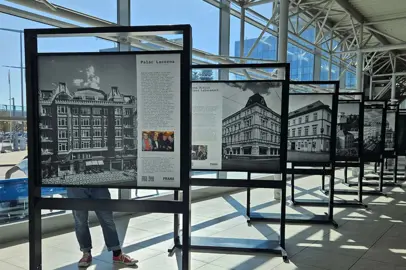
Prague Airport celebrates Václav Havel with exhibitions and installations
The exhibitions are in the Art Zone of Terminal 2, in the public concourse between Terminals 1 and 2 and at Pier C after the controls; in Terminal 2 the monumental tapestry "The Flying Man" is also visible
AVION TOURISM MAGAZINE
in digital version
On this issue: The World Heritage Sites of Lazio