Kandinsky in Rome: over 70 works at Palazzo Bonaparte tell the story of the birth of abstractionism
Rome returns to dedicate a major exhibition to Vassily Kandinsky after more than 25 years. Until February 14, 2027, Palazzo Bonaparte, in Piazza Venezia, hosts a retrospective with over 70 works, created by Arthemisia in collaboration with the Centre Pompidou in Paris and curated by Angela Lampe. The itinerary follows the artist's evolution from the figurative beginnings to the birth of abstraction, passing through the Blaue Reiter, the years of revolutionary Russia, the Bauhaus and the last French season.
The exhibition represents one of the cultural events of the autumn and winter season of the capital. A substantial part of the works comes from the collections of the Centre Pompidou, which preserves one of the most important nuclei in the world dedicated to Kandinsky thanks to donations and the bequest of his wife Nina Kandinsky. The Parisian museum confirms that the Roman exhibition is divided into five chapters and follows the artist's path through Russia, Germany and France.
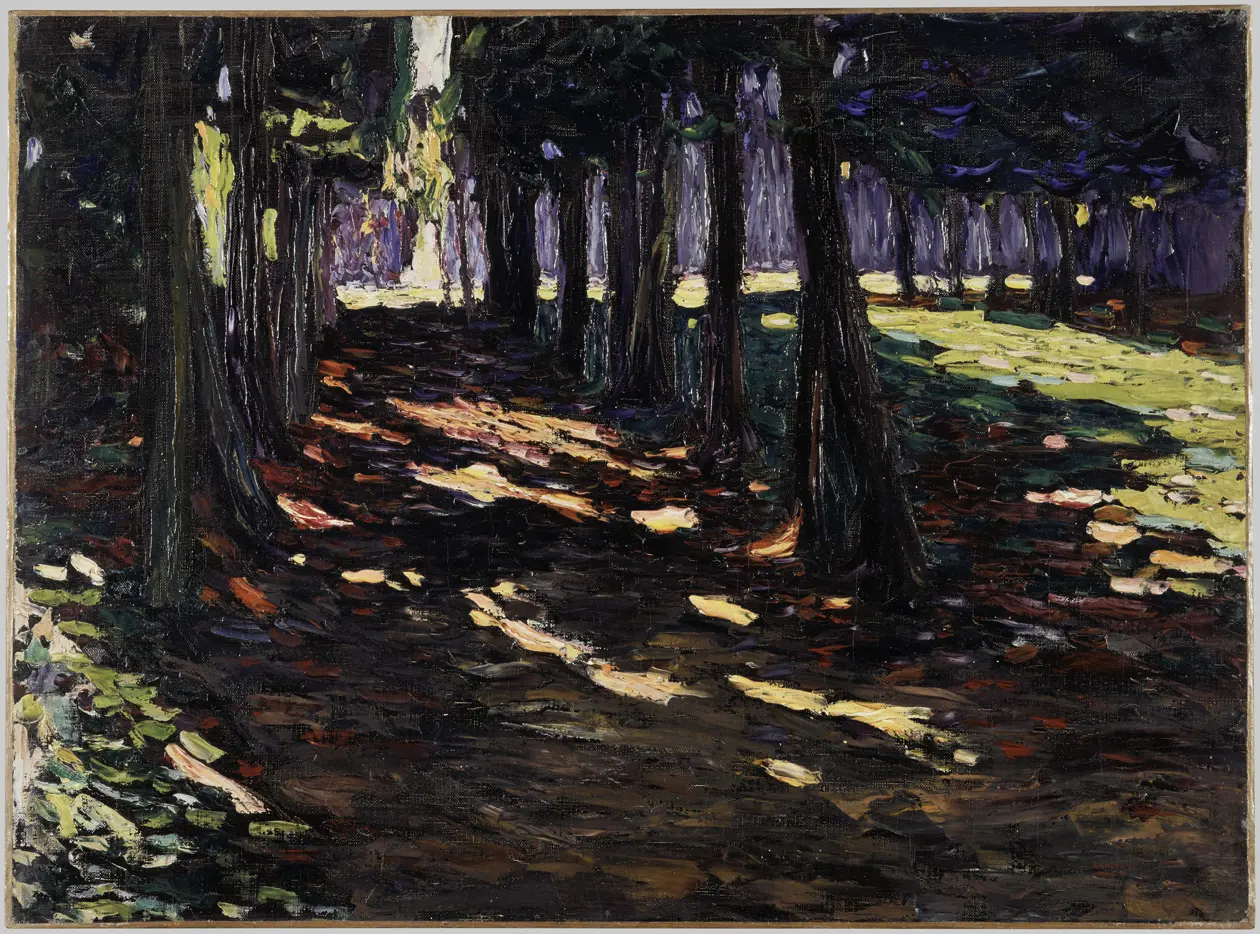
1906Huile sur toile, 48x65 cm Legs de Nina Kandinsky, 1981 Collection Centre Pompidou. Domaine public. Photo © Centre Pompidou, MNAM-CCI/Hélène Mauri/Dist. GrandPalaisRmn
From Munich to the Bauhaus: five sections to follow Kandinsky
Rather than focusing exclusively on the best-known abstract works, the Palazzo Bonaparte itinerary allows us to observe the progressive transformation of Kandinsky's language.
The five sections begin with training and the first still figurative works, continue with the years of Munich and Murnau, when color and form gradually begin to free themselves from the representation of reality, and arrive at the season of Der Blaue Reiter, the movement founded in 1911 together with Franz Marc with the contribution of Gabriele Münter.
This is followed by the years spent again in Russia during the revolutionary period, the experience at the Bauhaus, where Kandinsky taught and further developed his theories on the relationship between shapes, colors and composition, and finally the Parisian period, from his move to France in 1933 to his death in 1944.
It is an approach that allows even the less experienced visitor to understand how abstraction did not appear suddenly, but was the result of a gradual process of research into the relationship between image, perception, color and music.
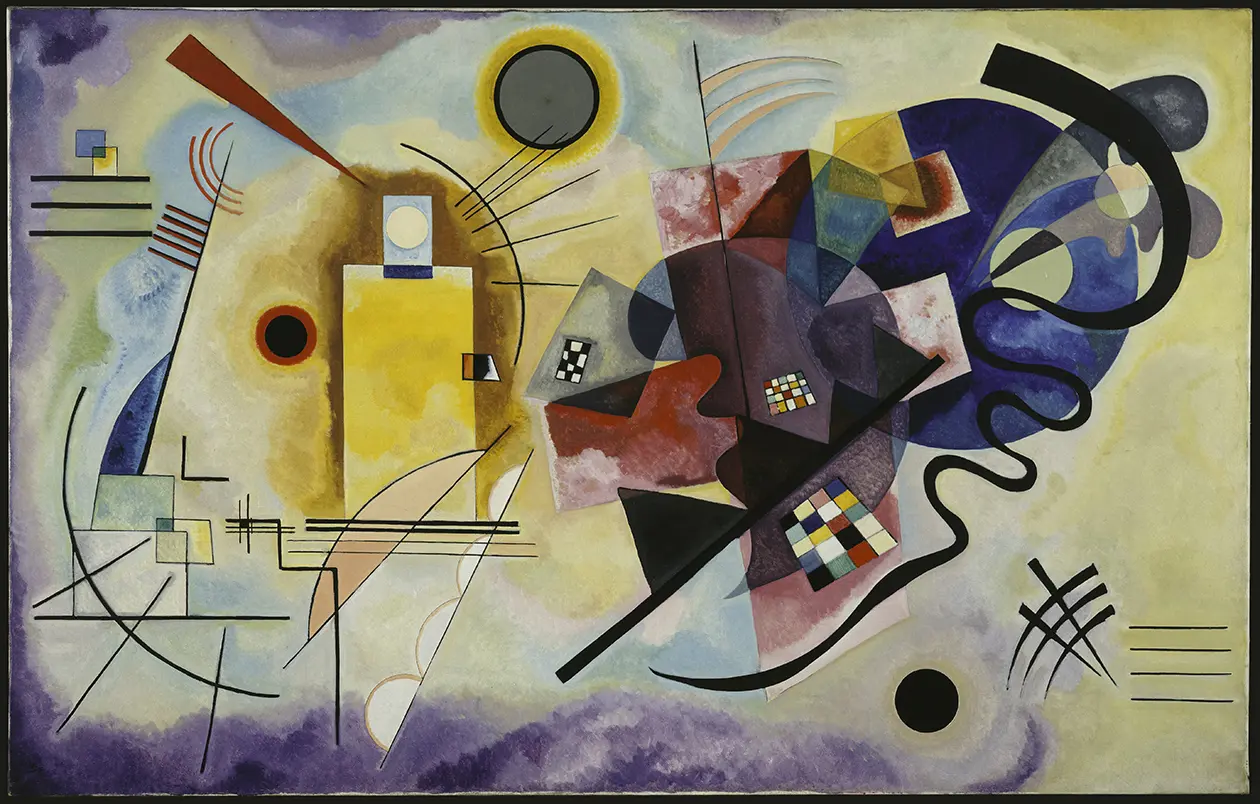
Gelb-Rot-Blau and The Black Arch among the works on display
Among the central works of the exhibition is Gelb-Rot-Blau (Yellow-Red-Blue) from 1925, one of the most representative paintings of the Bauhaus period, in which geometric shapes and chromatic backgrounds build a composition free from naturalistic representation. The work, from the Centre Pompidou, measures over two meters in width and entered the museum's collection through the donation of Nina Kandinsky in 1976.
The exhibition also includes The Black Arch, from 1912, belonging to the decisive season in which the painter developed a language increasingly autonomous from visible reality. These works are flanked by paintings, watercolors and materials capable of documenting different moments of his research.
The Centre Pompidou also points out among the works temporarily present in Palazzo Bonaparte Impression V (Parc) of 1911, Composition IX of 1936, Accent en rose of 1926 and works of the early twentieth century such as Alte Stadt II and Arabische Stadt, thus offering a chronologically extended reading of Kandinsky's production.
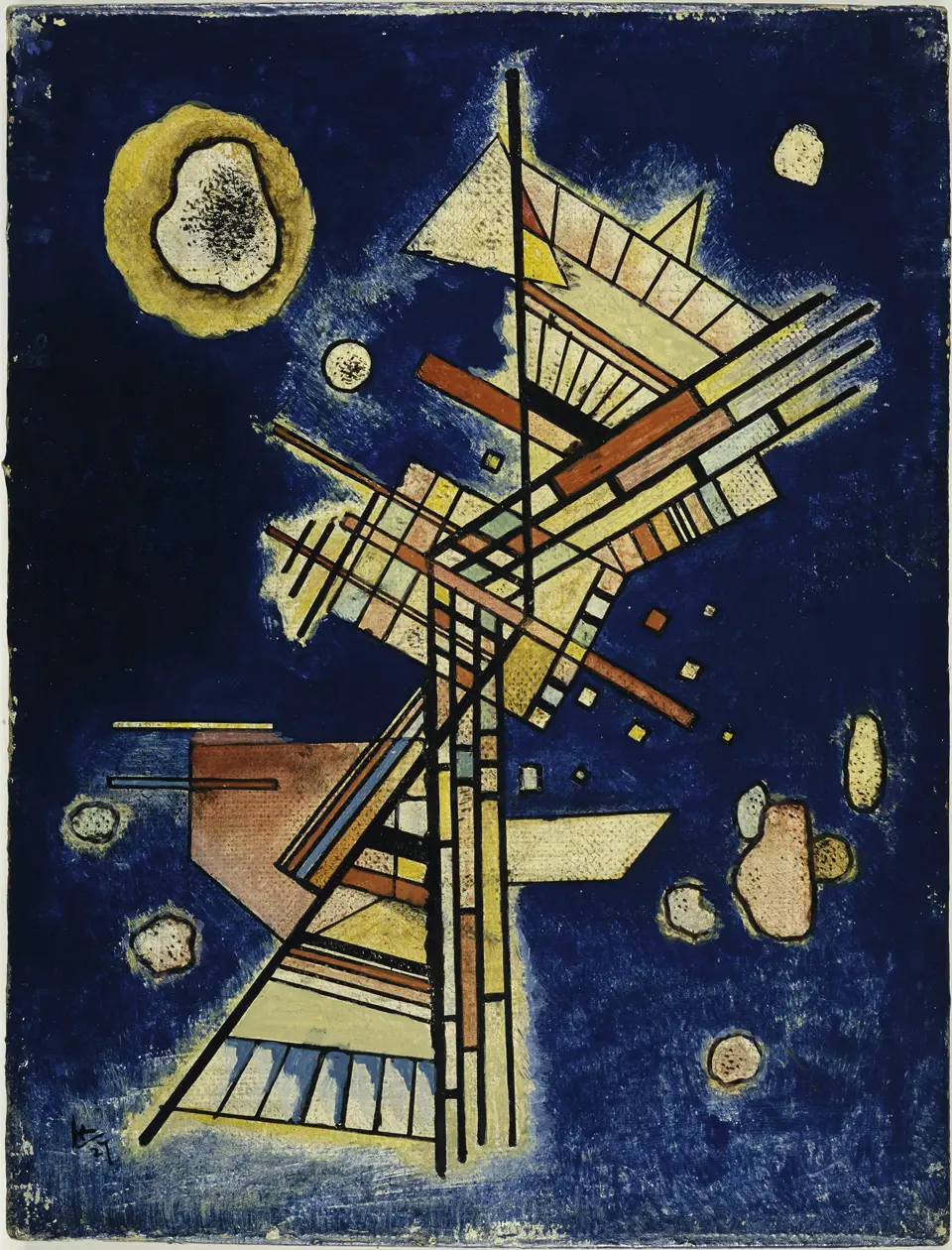
Huile sur toile marouflée sur bois, 26.1x19.9x1.2 cmLegs de Nina Kandinsky, 1981 Collection Centre Pompidou. Domaine public. Photo © Centre Pompidou, MNAM-CCI/Hélène Mauri/Dist. GrandPalaisRmn
The relationship between painting, color and music
One of the central themes of the exhibition concerns Kandinsky's belief that color and shape could produce an emotional effect comparable to that of music.
Two experiences are indicated as decisive in the formation of his research: the vision of Claude Monet's Sheaves, which showed him how an image could exert a strong impact even when the subject became less recognizable, and listening to Richard Wagner's Lohengrin at the Bolshoi Theater in Moscow.
This reflection would accompany Kandinsky for much of his career and find theoretical formulation in texts such as On the Spiritual in Art and, during the Bauhaus period, Point and Line on the Plane.
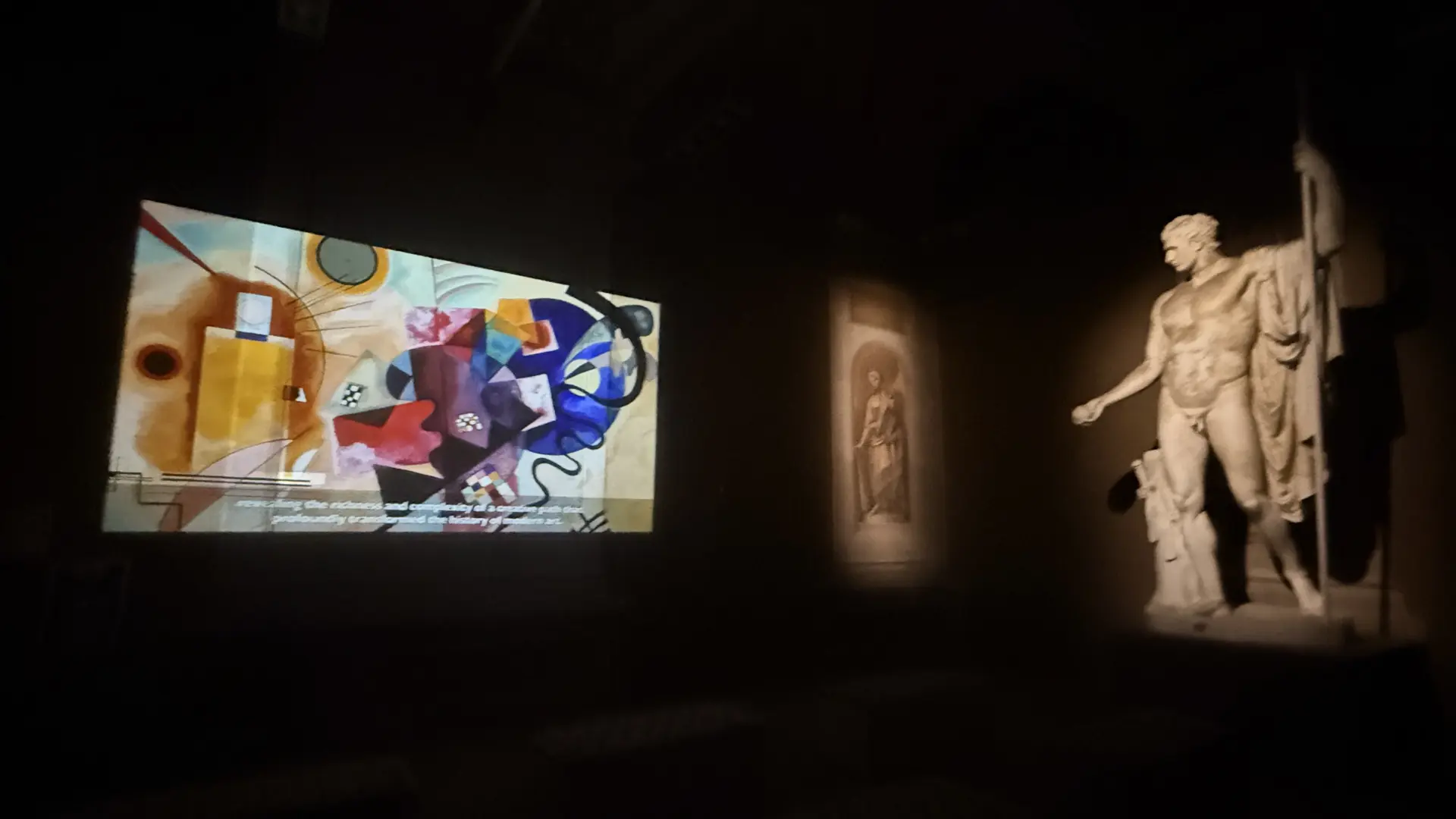
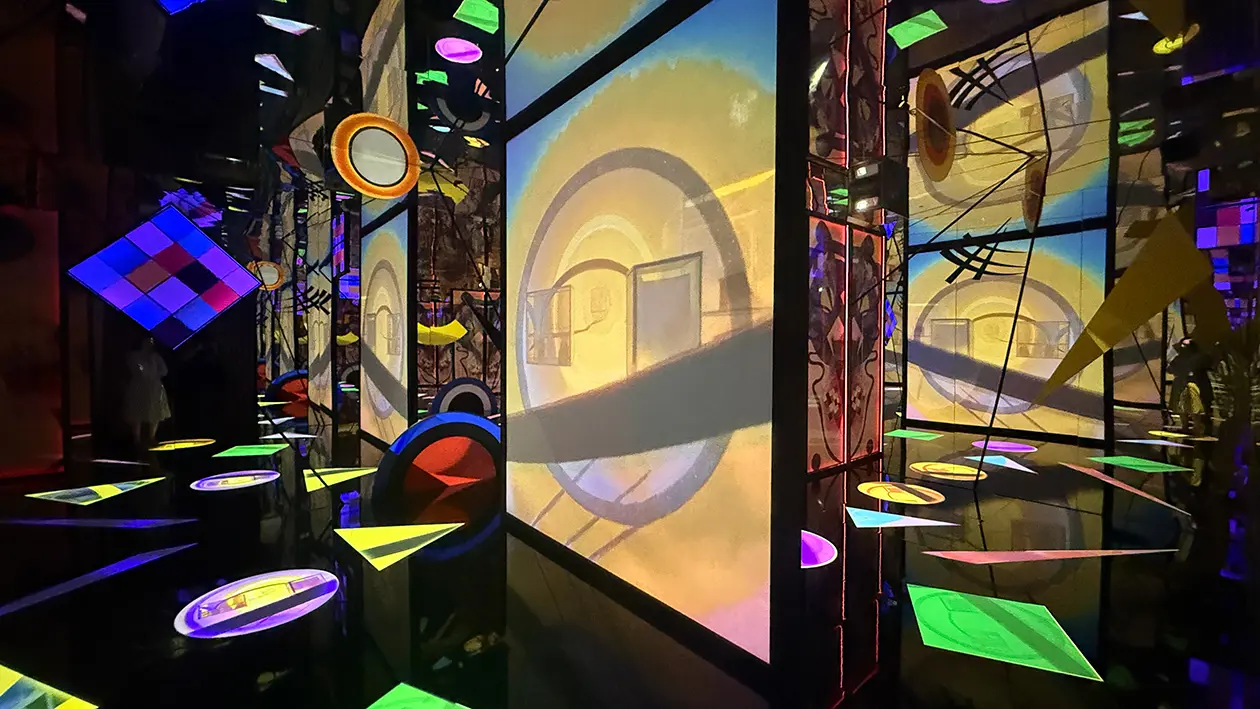
The exhibition explores this relationship between painting and music and also includes an immersive room, designed to translate the artist's geometries and colors into an environmental experience.
Gabriele Münter, beyond the relationship with Kandinsky
A specific section is dedicated to Gabriele Münter, a German artist and protagonist of the avant-garde of the early twentieth century, long remembered above all for her personal relationship with Kandinsky. The works on display, on the other hand, allow us to reconstruct an autonomous research, characterized by marked contours, simplification of forms and intense chromatic backgrounds. Münter participated directly in the experiences of the Blaue Reiter and contributed to the climate of experimentation that accompanied the birth of abstraction.
During the Nazi period he also played a fundamental role in the preservation of numerous works of the movement, saving them from dispersion and destruction.
The focus thus adds to the retrospective a broader perspective on the cultural environment in which Kandinsky's artistic revolution matured.
Photographs, letters and personal items
Alongside the paintings, the itinerary includes photographs, documents, letters, biographical materials and personal objects, some of which come from the Bibliothèque Kandinsky.
These materials help to place the works within the artist's biography and the numerous movements that marked his life: from Russia to Germany, from European travels to the years spent in Murnau, from the Bauhaus to his definitive move to the Paris area.
Some tools and objects from the French atelier also reconstruct the working environment of recent years, when Kandinsky began to combine the geometry developed during the Bauhaus with more organic and biomorphic forms.
INFO Exhibition: Kandisky