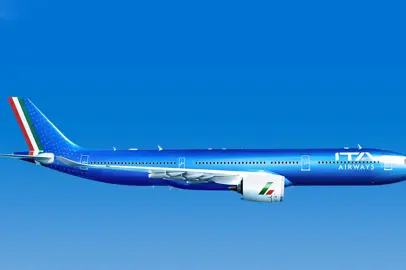
ITA Airways introduces Iris satellite technology on European flights
Viasat Inc., a global leader in satellite communications, has announced the adoption of Iris technology by ITA Airways, Italy's national carrier. The Iris programme, developed by the European Space Agency (ESA) and led by Viasat, represents one of the most advanced initiatives for the modernisation of European air traffic management (ATM).
The service, certified by ESSP and supported by Iris Service Provider, involves 19 major European air navigation service providers (ANSPs) during the pre-commercial flight phase, which will end by the end of 2025. From 2026, the progressive deployment will begin with the aim of integrating 28 ANSPs of the Single European Sky (SES) 2+ project by 2032 and supporting over 1,100 aircraft equipped with Iris technology.
A key advance towards the Single European Sky
ITA Airways is one of the first airlines in Europe to introduce Iris as an operational support for the future of ATM. The technology will initially be installed on four Airbus A320neo aircraft in the fleet, contributing to the modernisation of European airspace and reducing environmental impact.
Through the use of Viasat's SB-S satellite communications, Iris allows the start of 4D Trajectory-Based Operations (4D-TBO): a model that allows precise data to be shared on the flight path, avoiding waits in the circuit, choosing shorter routes, maintaining optimal altitudes and applying continuous climb/descent profiles. This results in fewer delays, reduced fuel consumption and lower emissions.
More efficient Italian routes
ITA Airways' first Iris-enabled flights will take off from Milan and Rome airports to European destinations, offering passengers greater operational regularity and a more sustainable journey.
A standard destined to go global
The program is expanding its reach beyond Europe through the Iris SATCOM Global Solution, which aims to export the benefits of fuel savings, CO₂ reduction and decongestion to Asia and the Americas as well. By 2028, Iris will be able to support the optimization of flights worldwide.